
Watch someone work a piece of batik and it’s easy to see why the craft has held on for so long: wax going down in careful lines, colour soaking into everything the wax doesn’t cover, then the wax coming away to reveal a pattern that was hiding under it the whole time. It looks a little like a magic trick the first time you see it, and it’s one of the few crafts where watching it being made genuinely changes how you see the finished piece afterwards. Club Hotel Dolphin has started running a Batik Factory Visit for guests who want to watch that trick happen up close, and it’s a good excuse to look at how batik in Sri Lanka actually works, and where it came from in the first place.
What Batik Actually Is
Batik is a wax-resist dyeing technique: wax is applied to parts of a fabric to stop dye from reaching it, the fabric is dyed, and the waxed areas stay their original colour underneath. The word itself comes from Javanese, combining “amba” (to write) and “titik” (dot or point), which gives a fair sense of how the pattern actually gets built, point by point, line by line, rather than printed all at once.
The technique is practised well beyond Indonesia, where it reached its most elaborate form, with distinct traditions in India, China, West Africa, and Sri Lanka. What makes each version different isn’t the wax-and-dye method itself, which stays broadly the same everywhere, but the motifs, colours, and meanings each culture has layered onto it.
How Batik in Sri Lanka Took Shape
Batik arrived in Sri Lanka during the Dutch colonial period, most likely carried along the same trade routes that connected the Dutch East India Company’s ports with the Indonesian archipelago. Some accounts also point to Javanese royals and artisans exiled to Ceylon during this period, who would have brought the technique with them directly rather than it arriving purely through trade.
For much of the 19th century, batik stayed a pastime among Kandyan court ladies and the local elite, worked into fabric for personal use rather than produced commercially. That changed through the 20th century, as batik grew into a proper cottage industry, helped along by bodies like the National Crafts Council and a tourism boom from the 1960s onward that gave artisans a steady market for their work. Sri Lankan batik developed its own visual identity along the way: peacocks for beauty, lotus flowers for purity, and patterns drawing on Sinhalese and Tamil design traditions rather than directly copying Javanese motifs.
That cottage-industry model has largely held. Many of the workshops still operating today are family businesses, with the craft passed down rather than taught from scratch each generation, and the process itself hasn’t really changed even as the designs have. Natural dyes and hand-finishing also mean the whole method sits fairly comfortably alongside the current interest in slower, more sustainable ways of making textiles, even though batik was doing all of that long before it had a name for it.
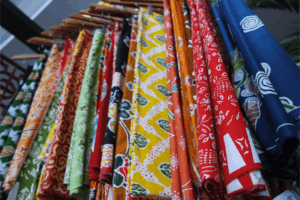
The Process, Step by Step
A batik piece usually starts with a design sketched onto stretched cotton or silk, often in pencil before anything else touches the fabric. Hot wax then goes over the lines that should stay their current colour, traditionally applied with a spouted tool called a canting, or with a brush for bolder, simpler shapes. Once the wax has set, the fabric goes into a dye bath, and everywhere the wax didn’t reach takes on the new colour.
For pieces with more than one colour, that cycle of waxing and dyeing repeats, each layer protecting what’s already been coloured while opening up new sections to the next dye bath. Some pieces also get a second, fuller layer of wax across the whole fabric before a final dye bath. As that wax cools and hardens, it naturally cracks in places, and dye seeps into those cracks to create the fine, marbled lines batik is often recognised by. It’s a deliberate effect rather than a flaw, and it’s one of the details that makes a hand-finished piece look genuinely different from a printed imitation.
The final step is removing the wax entirely, usually by boiling the fabric or ironing it between sheets of paper, which is the moment the finished pattern actually appears in full for the first time. It’s a slow process by design. A single hand-drawn piece can take days to finish properly, which is part of why no two batik pieces turn out quite the same.
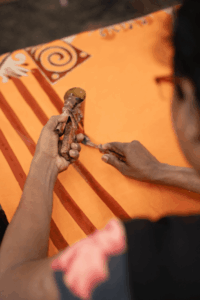
Watching It Happen at Club Hotel Dolphin
Club Hotel Dolphin’s Batik Factory Visit walks guests through that same process in person: watching the first lines of a design get drawn, seeing the wax go on, following the fabric through its dye bath, and staying for the reveal once the wax comes off. It’s less a demonstration to watch from a distance than a chance to stand next to the people who actually do this for a living and ask them how it’s done, which tends to land differently than reading about a craft or seeing it framed on a wall somewhere.
That’s really the value of an experience like this over just buying a finished piece in a shop. Seeing how long a single design takes, how much of it happens by hand rather than machine, and how much judgement goes into where the wax lines land, changes what a batik sarong or wall hanging actually represents once you’re holding one afterwards.
Guests weighing up all inclusive hotels in Sri Lanka that build a bit of local culture into an otherwise beach-and-pool stay might find this a useful example of what that can look like in practice. It’s the kind of add-on that doesn’t need a full day set aside for it, and it fits naturally alongside everything else already on offer at the resort, from the 171-metre pool to Mango Village. Exact timings and how to book are best confirmed with the team once you’re there, since these things tend to run on a flexible schedule rather than a fixed slot. It’s a small but genuine example of what batik in Sri Lanka looks like outside a shop window, made rather than just sold.
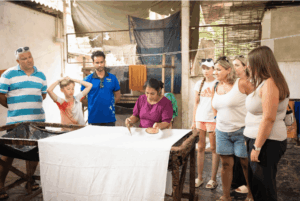
Plan Your Stay
A stay at Club Hotel Dolphin doesn’t have to be just beach, pool, and buffet. Between Mango Village’s cooking experience and now a proper look at how batik is made, there’s a real thread of local craft and culture running through the resort’s activity programme, alongside all the usual reasons people come here in the first place.
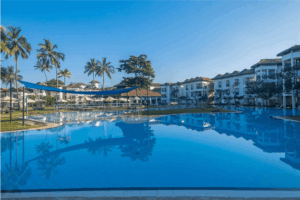
Explore the hotel’s accommodation and current offers, or contact Club Hotel Dolphin for help planning your stay. Ask about the Batik Factory Visit when you book, and you’ll come home with more than a tan.

