
The rock and Pidurangala are the best-known of the Sigiriya tourist attractions, but the birds make themselves known as they flitter around the trees. A wide range of species are found around the forests, moats and village tanks, with several found only in Sri Lanka. Birdwatching in Sigiriya needs no prior knowledge and requires you to carry very little. Just a pair of binoculars, a quiet hour after the first light, and someone who knows the calls. This guide covers when to go, where the birds are, what to bring, and what a first morning delivers.
Why Early Morning Matters
Birds are most active in the first two or three hours after first light, around 6 am, and the calls fade by mid-morning as the heat builds. Late afternoon offers a second, shorter window. Midday is quiet.
Dawn also brings the best light and the fewest people on the paths. A sample morning:
- 5.45 am: a hot drink and a meeting point with the guide.
- 6 am: set off at first light, when the forest is loudest.
- 8.30 am: back for breakfast before the heat builds, with the rest of the day free for other things to do in Sigiriya.
The season changes what you see. Migratory species arrive from about October, and November to April is the stretch most birders aim for. November can bring short showers, and December to February is when migrants are most numerous.
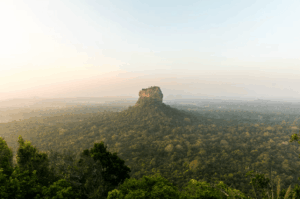
Habitats Around Sigiriya
Sigiriya is a dry-zone landscape, and the birds sort themselves by habitat. Five matter for a first walk:
- Forest in the reserve. The dry forest around the rock holds the endemics beginners most want to see: Sri Lanka grey hornbill, Sri Lanka junglefowl, brown-capped babbler, and Sri Lanka green pigeon.
- Moats and water gardens. Still water draws kingfishers and herons.
- Village tanks and paddy fields. Egrets, jacanas, and cormorants feed here, with raptors overhead.
- Gardens and open ground. Peafowl, bulbuls, and barbets are the easy sightings.
- The larger tanks at Minneriya and Kaudulla. A half-day trip adds waterbirds and eagles.
Birds gather where two habitats meet, such as a forest edge against open ground or a tank, so slow walks along edges beat deep forest for a first morning.
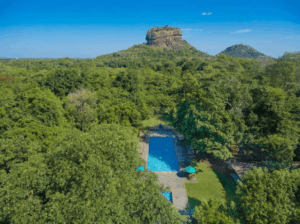
Anyone comparing hotels in Sigiriya for a birdwatching stay should look at what is outside the door. Hotel Sigiriya sits inside the natural reserve, so the forest habitat is on the doorstep, not a drive away.
What to Bring: Binoculars, Clothing, and Extras
Binoculars matter more than a camera. A pair rated 8×42 is a common beginner choice: wide enough to find a bird quickly, bright enough for forest shade, and steady enough to hold by hand. Ask Hotel Sigiriya beforehand whether binoculars are provided on a naturalist-led walk, so you know whether to pack your own.
Binoculars take practice, and a short routine helps:
- Find the bird with your eyes first, and keep looking at it.
- Raise the binoculars to your eyes without looking away from the bird.
- Describe where it is by landmark, such as “the dead branch left of the tall tree”, so the guide can get you onto it.
A phone held steady against the eyepiece takes a usable identification photo, which is enough to look the bird up later. A long lens is not needed for a first walk.
For the rest of your kit:
- Colours. Muted greens, browns, and greys. Bright colours and white stand out against the forest.
- Clothing. Long trousers and a light, long-sleeved top for sun and insects, plus a brimmed hat.
- Footwear. Closed shoes with grip, since the paths are uneven.
- Rain layer. A light jacket for November, when short, heavy showers arrive.
- Extras. Insect repellent, sunscreen, water, a field guide or bird-ID app, and a notebook for the birds you can’t name yet.
Why Go With a Guide
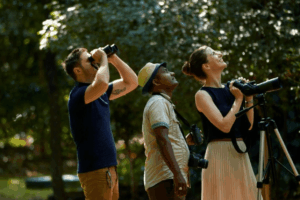
Most birds are heard before they are seen, and a beginner can walk past a hornbill without noticing it. A guide hears the call, finds the bird, and gets you onto it. For birdwatching in Sigiriya, that turns an hour of green blur into a list of named species. A guide also explains behaviour, such as why Sri Lanka grey hornbills move in pairs and small family groups, which makes a sighting memorable as well as ticked off.
Hotel Sigiriya’s resident naturalist leads birdwatching and nature trails as part of its Sigiriya wildlife experiences. The hotel also has an Interpretation Centre with wildlife documentaries and an Eco-Centre. Arrange the walk with the hotel the day before, so the start time fits first light.
Watching Respectfully
Birds and the habitat they depend on are easily disturbed. A few rules protect both:
- Keep to the paths and let the guide set the pace.
- Stay quiet, and keep your distance from nests and roosts.
- Use no flash, and never play recorded calls to draw a bird out.
- Do not feed wildlife.
- Wild elephants pass through the area, so stay with the guide at dawn and dusk and follow instructions at once.
What You Can Realistically Expect to See
No walk guarantees a species. A first morning looks like this:
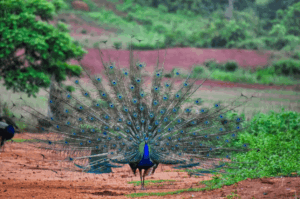
- Common here: Indian peafowl, Sri Lanka grey hornbill, red-vented bulbul, and coppersmith barbet.
- Reported regularly with a guide: Sri Lanka junglefowl, brown-capped babbler, Sri Lanka woodshrike, and Sri Lanka green pigeon.
- A bonus, not a given: Malabar pied hornbill, kingfishers, raptors over the tanks, and, in season, migrants such as the Indian pitta.
A quiet morning still teaches the calls and habits that make the next walk easier.
Fitting Birdwatching in Sigiriya Into a Short Stay
A bird walk takes two to three hours, and it competes for the same dawn as the stay’s other big outings. The rock and Pidurangala are the two attractions closest to the hotel, at around 2 and 4.2 kilometres, and both reward an early start too. Never stack two dawn starts in one morning.
- Two mornings: give one to the birds and one to a climb.
- Three mornings: add the Dambulla Cave Temple, which suits an early start or a late-afternoon visit.
The hotel’s experiences page covers the rest of each day.
Plan Your Stay
Hotel Sigiriya sits inside the Sigiriya natural reserve, with a resident naturalist, an Interpretation Centre, and an Eco-Centre on site. For a November to January trip, a naturalist-led walk at first light is an easy morning to add.
Explore the hotel’s accommodation and current offers, or contact Hotel Sigiriya for help planning your stay. Start or end your stay with a bird walk; either will bring in new songs.


