
Most people who go to Minneriya go for the sheer scale of the gathering: hundreds of wild elephants in one place, more than almost anywhere else on earth. That’s a fair reason to go.
But the more interesting story isn’t how many elephants turn up. It’s what their turning up together actually reveals, since elephants don’t normally live this way at all. A Sri Lankan elephant gathering on this scale is less a spectacle than a rare, visible exception to how these animals usually organise their lives.
Meet the Sri Lankan Elephant
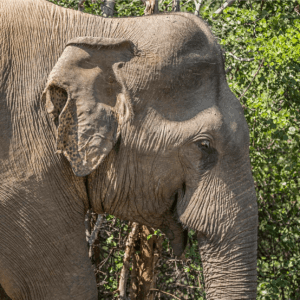
The Sri Lankan elephant is a subspecies of the Asian elephant, and by most measures the largest and darkest of the group. Patches of depigmentation on the ears, face, trunk, and belly give individuals genuinely distinctive markings.
One trait sets them apart even from their closest relatives: tusks are rare. Females essentially never grow them, and only around 5 to 10 percent of males do. That means the vast majority of Sri Lankan elephants you’ll ever see, gathering or otherwise, are naturally tuskless.
That’s worth knowing before a safari, if only because it corrects an expectation many visitors arrive with. The image of an elephant with sweeping tusks is more African elephant than Sri Lankan, and looking for one here is largely a losing game. It’s also a reminder that most of what people expect an elephant to look like comes from one subspecies out of several, and Sri Lanka’s version has its own set of traits worth knowing before you go looking for it.
How Elephant Society Actually Works
Sri Lankan elephants live in matriarchal family groups, usually led by the oldest female. That matriarch isn’t just senior by age, she carries the herd’s working memory of water sources and migration routes, built up over decades and drawn on heavily when the dry season forces a herd to travel.
A few things define how that society actually functions:
- Fission-fusion structure. Herds aren’t fixed units. Family groups split apart and rejoin depending on conditions, rather than staying together as one static group year-round.
- Males leave, females stay. Males leave the family entirely once they reach maturity, moving into solitary lives or loose, temporary bachelor groups. Female relatives tend to stay together for life, which is part of why a herd sighting is really a sighting of an extended family, not a random assortment of individuals.
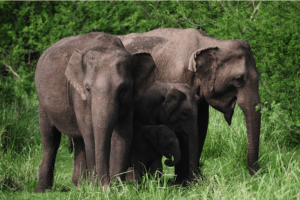
- Two common herd types. Nursing units, made up of lactating females and their young calves, and juvenile care units, where females look after slightly older offspring.
- Documented caregiving. Sick or injured elephants have been observed staying under the protection of the wider group rather than being left behind.
- Tool use, taught rather than instinctive. Elephants use branches for scratching or swatting flies, a skill younger elephants pick up by watching older ones rather than working out alone.
Why the Sri Lankan Elephant Gathering Happens
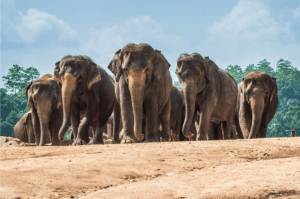
The mechanics are straightforward enough. Minneriya sits around an ancient reservoir, and through the dry season, roughly July to October, its water level drops and exposes fresh grass on the tank bed. Elephants move in from surrounding forest to reach both.
Water and grazing become genuinely scarce elsewhere in the dry months, and that pull is strong enough to draw multiple separate family groups to the same stretch of shoreline at once. That last part is the genuinely unusual bit. Family clans mostly keep to themselves under normal conditions, socialising within their own group rather than mixing widely with others. The Gathering forces an exception: several unrelated clans converging in the same open space, at the same time, for as long as the dry season holds.
It’s one of the few settings where interactions between separate family groups become visible at all, including behaviour researchers otherwise rarely get to observe in the wild:
- Trunk touches between elephants from different family groups
- Vocalisations exchanged as groups approach one another
- Brief investigations of an unfamiliar calf by elephants outside its immediate family
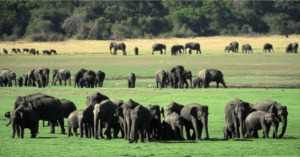
Numbers during the peak weeks of a Sri Lankan elephant gathering can run into the hundreds, but the social mixing happening within that crowd is arguably the rarer sight of the two.
A Rare Window for Researchers Too
Scientific understanding of Asian elephant social structure actually lags behind what’s known about their African counterparts, largely because Asian elephants tend to live in denser, lower-visibility habitat that makes sustained observation difficult. Sri Lanka’s national parks, Minneriya included, are among the few places open enough to study this behaviour properly.
Research conducted at sites like Minneriya, Yala, and Udawalawe has been used to better understand how group size and social bonds shift with conditions like water and food availability. That work has turned up a consistent pattern across otherwise different parks: strong core bonds, usually among related females, sit inside a much looser and more variable web of weaker associations with other elephants.
In other words, the tight matriarchal family is fairly constant everywhere, but how much that family interacts with others outside it depends heavily on local conditions, exactly the kind of shift a dry-season gathering like Minneriya’s makes temporarily visible.
That research matters beyond curiosity, too. A clearer picture of how elephant society actually functions feeds directly into conservation planning, since decisions about corridors and protected land work better when they’re based on how elephants actually move and associate, not just where they’re seen most often. Sri Lanka’s elephant population already faces real pressure from habitat loss and conflict with nearby communities, which makes that kind of research more than an academic exercise.
Seeing This Up Close
A standard jeep safari will get you to the water’s edge for the numbers. What it won’t always do is explain what you’re actually looking at: whether a cluster of elephants near the tree line is a nursing unit or a temporary mixing of two separate clans, or why one adolescent male is hanging back from the main group rather than joining it.
That’s where a naturalist-led safari earns its keep, turning a count of elephants into an actual reading of what’s happening between them, the same way a guide at a historical site turns a pile of stones into a story. Hotel Sigiriya’s resident naturalist runs safaris with exactly this in mind, alongside the wider run of things to do in Sigiriya that make a longer Cultural Triangle stay worth building around more than one big sighting.
Plan Your Stay
Understanding a bit of elephant society before you go changes what a Minneriya safari actually shows you, and having a naturalist along for the ride is the difference between watching elephants and understanding them. Hotel Sigiriya’s location and resident naturalist make that the easier option rather than the harder one.
Explore the hotel’s accommodation and current offers, or contact Hotel Sigiriya for help planning your stay. However many elephants you count at the water’s edge, it’s the ones you understand that you’ll actually remember.


