
Walk past a stall selling Sri Lankan masks and it’s easy to assume they’re purely decorative, something colourful to hang on a wall back home. The full story is a lot stranger and more specific than that. Some of these masks were carved to cure disease. Others were built to mock colonial rulers to their face, through performance, without ever saying a word directly. Ambalangoda masks carry that whole range of purpose, and it’s worth knowing before you see a single one in person.
Where the Craft Comes From
Ambalangoda, a coastal town in Sri Lanka’s Southern Province, has been the centre of the country’s mask-carving tradition for generations. The craft itself traces back to at least the 15th century, rooted in pre-Buddhist beliefs around devils, disease, and healing that predate the mask-making families still practising today.
One name comes up constantly in Ambalangoda: Ariyapala. The Wijesuriya family has carried this craft forward for roughly five generations, running what’s now a combined museum, workshop, and library out of the town, named after an ancestor, Ariyapala Wijesuriya Gurunnanse, considered one of Sri Lanka’s most accomplished master carvers. It’s a genuinely rare setup: a working family business that’s also become the country’s primary archive of its own mask history.
That combination matters more than it might first seem. Most craft traditions that survive tourism end up either frozen as museum pieces or diluted into generic souvenirs. Ambalangoda has largely avoided both, mainly because the people carving today are direct descendants of the people who carved a century ago, working from the same designs and the same understanding of what each mask is actually for.
Three Kinds of Mask, Three Very Different Purposes
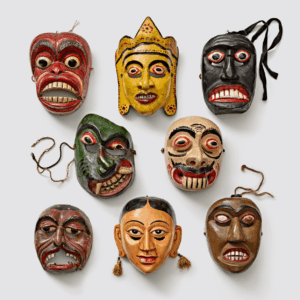
Sri Lankan masks aren’t one tradition wearing different faces. They split into three distinct categories, each built for a different job:
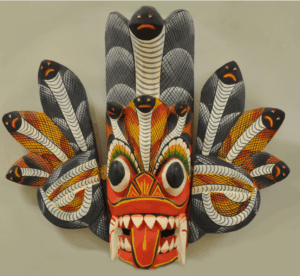
- Raksha masks. Demon masks, built to intimidate: bulging eyes, bared fangs, and in some designs, multiple serpent heads rising off the top. Used in processions and festivals, largely to ward off evil rather than represent it favourably.
- Kolam masks. Used in a form of folk theatre that blends mime, dance, and satire. Kolam performances date to the colonial period and were historically staged on beaches or in paddy fields, with ordinary villagers using the anonymity of a mask to poke fun at colonial authorities in ways that would have been risky to say outright.
- Sanni masks. The most unusual of the three. Sanni masks belong to a healing ritual called Sanni Yakuma, and there are traditionally 18 of them, the Daha Ata Sanniya, each one representing a specific ailment, from stomach complaints to nightmares. A ritual performer called an edura would wear the relevant mask as part of a ceremony intended to draw that particular affliction out of a sick person.
How Ambalangoda Masks Are Made
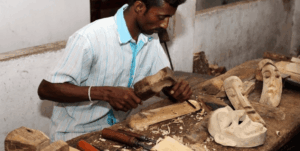
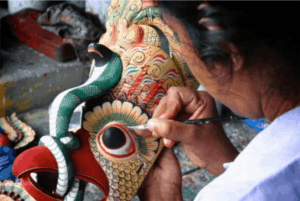
Every mask starts as a block of kaduru, a light, easily worked wood chosen specifically because it carves cleanly without splitting. A carver works the block by hand into the mask’s base shape, wide mouths, exaggerated eyes, ornate headpieces, before it’s handed off for painting in the bold, saturated colours these masks are known for.
None of this happens quickly. A detailed Raksha or Sanni mask can take days of carving alone, and the painting adds further time on top, often built up in layers rather than applied in one pass. Watching it happen at the workshop attached to the museum makes that clear in a way looking at a finished mask on a wall doesn’t: this is slow, deliberate handwork, not something turned out on a production line for the tourist trade. Even the tools tend to be simple, hand chisels rather than anything mechanised, which is part of why no two masks, even of the same design, ever come out quite identical.
A Few Masks Worth Knowing by Name
Within those three categories, certain individual designs come up again and again. The Naga Raksha, or cobra demon, is one of the most recognisable Ambalangoda masks: a snarling face topped with a crown of cobra hoods, meant to embody a specific kind of malevolent power rather than evil in general. Among the Sanni masks, Maru Sanniya represents death itself, one of the more severe entries in the set of eighteen, while others cover far more mundane complaints, stomach pain, fainting, and fever among them.
That range, from death to an upset stomach, says something about how these masks were originally used. They weren’t reserved for dramatic occasions alone. Sanni Yakuma was a practical response to ordinary illness, and the masks reflect that: a full working system for a village with no other explanation for why someone had suddenly fallen sick.
A Craft Still Holding On
The beliefs that originally supported this tradition have faded considerably. Sanni Yakuma ceremonies are rarely performed for their original healing purpose anymore, and Kolam theatre has lost ground to television and other modern entertainment. By most accounts, the practical, everyday need for these masks largely disappeared decades ago, replaced by medicine on one side and screens on the other.
What’s kept the craft alive since is tourism, and the same handful of families, the Wijesuriyas chief among them, still training the next generation in a skill that no longer has the ritual demand it once did. It’s a genuine trade-off: a mask bought as a souvenir today is one of the reasons the carving itself hasn’t died out entirely. Whether that counts as the tradition surviving or simply changing shape depends a bit on how you look at it, but either way, the alternative was almost certainly losing it altogether.
Seeing It for Yourself
The museum and workshop in Ambalangoda make this an easy, self-contained visit. A single stop takes you through a proper collection of masks organised by type, into a workshop where carvers are often at work in person, and finishes at a shop where you can buy a piece directly from the people who made it. Most visits are guided, with staff on hand to explain the history and meaning behind individual pieces rather than leaving you to guess.
It’s a natural addition to a wider list of things to do in Bentota, particularly for anyone who wants their trip to include something more specific than beaches and water sports.
Plan Your Stay
Thaala Bentota sits close enough to Ambalangoda to fold a visit into a single half-day out, leaving the rest of your stay for the resort’s own stretch of coastline. A morning spent watching centuries-old craft take shape by hand is a good contrast to an afternoon doing nothing at all by the water.
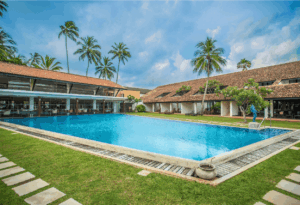
Explore the hotel’s accommodation and current offers, or contact Thaala Bentota for help planning your stay. Whichever mask catches your eye, it was carved to mean something specific, worth asking what before you buy.


