
Geoffrey Bawa had no training as an architect when he bought a run-down rubber plantation on the edge of Dedduwa Lake in 1948. He was a lawyer in his late twenties who’d failed to buy an Italian villa and decided to build something like one in Sri Lanka instead. What followed was roughly fifty years of him reshaping that same plot of land, on and off, for the rest of his life. Lunuganga garden isn’t a finished commission so much as a record of one man’s design thinking, changing his mind, over five decades.
From Rubber Plantation to Architect’s Laboratory
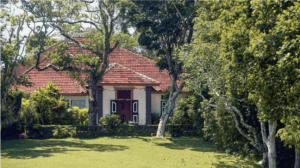
The land had already been through two lives before Bawa found it: a cinnamon estate under the Dutch, then a rubber plantation under the British. He bought it in 1948, on the edge of Sri Lankan independence, intending to turn the existing colonial bungalow into a weekend retreat with a garden in the style of a European Renaissance estate.
He quickly realised he didn’t have the skills to do it properly. Rather than hire someone else, Bawa went back to England to study architecture formally, then returned to Colombo and joined the practice of Edwards, Reid and Begg. Lunuganga became something closer to a training ground than a finished weekend house, the place he tried out ideas before they ever appeared in a paying commission.
The estate sits on a peninsula jutting into Dedduwa Lake, roughly 11 kilometres from Bentota railway station and about an hour from Galle. Its size gets reported differently depending on the source, somewhere between 15 and 25 acres, largely because the surrounding buffer land has expanded over the decades since Bawa’s original purchase.
A Garden Built Over Fifty Years
Bawa’s most intensive work on the estate ran from 1958 through to 1998, roughly four decades of continuous adjustment rather than a single completed project. He excavated cliffs to open up dramatic lake views, reoriented the original bungalow with new verandas and courtyards, and effectively turned the old colonial structure inside out while keeping its original shell intact.
That approach, treating a finished building as something still open to revision, became a defining trait of his later, professional work. Lunuganga is where he worked it out first, on his own property, with no client to answer to and no deadline forcing a final decision. Architects who study his later hotels and public buildings often point back to specific features here as the first version of an idea, tested on his own land before it was ever trusted to a client.
Few architects get a lifetime to keep revising a single project. Most of what makes Lunuganga garden worth visiting comes directly from that unusual freedom: an estate shaped by decades of second-guessing rather than one confident plan executed once.
Walking Through Lunuganga Garden
The estate is really a series of distinct spaces rather than one continuous garden, each named for a specific feature:
- The Red Terrace, named for its red laterite soil, overlooks the lake and the Water Garden below. It was reportedly one of Bawa’s favourite spots to eat lunch.
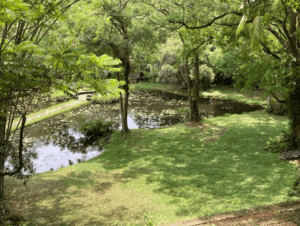
- The Water Garden, centred on a butterfly-shaped pond filled with pink water lilies, bordered by ornamental rice paddies running along the lake’s edge.
- The Yellow Courtyard, built around two neo-Gothic windows given to Bawa by a friend, with walls painted the ochre shade that gives the space its name.
- The Glass Room, Bawa’s own office within the estate, positioned to catch both the lake view and a sightline to the main gate.
- The Water Gate, the departure point for boat trips across Dedduwa Lake to two small islands, Appaladuwa and Honduwa, still used for excursions today.
Moving between these spaces on foot is really the point. Nothing here reveals itself all at once.
The Small Details That Give It Away
Some of the estate’s most telling touches are also its funniest. Bawa designed Sri Lanka’s Parliament House, and years later built a hen house on his own property in the same architectural style, whatever that says about how seriously he took himself. Scattered through the grounds are Ming dynasty-style jars, a rusted sundial sculpture, and a statue of the god Pan, made by one of his Tamil assistants and known simply as “Hindu Pan.” None of these were ever explained by Bawa himself, and the estate’s guides tend to present them as open questions rather than settled facts, which somehow suits the place better than a tidy explanation would.
The garden’s views were engineered as carefully as its buildings. Bawa was known for framing sightlines that reached well beyond the property’s own boundary, borrowing the surrounding landscape as part of the composition rather than confining the design to land he actually owned. That habit likely traces back to his older brother Bevis, whose own garden at nearby Brief Gardens predates Lunuganga and is thought to have first inspired Geoffrey to take up landscaping at all.
Materials matter throughout too. Bawa planted mangroves along parts of the shoreline as natural barriers, and the grounds hold a mix of balsa wood and ebony trees alongside the more ornamental planting. Vintage colonial-era furniture sits inside the buildings, collected rather than bought as a set, next to modern pieces Bawa designed himself, a mix that mirrors the garden’s own blend of old structure and new addition.
Visiting Lunuganga Today
The estate is now managed by the Geoffrey Bawa Trust, a non-profit set up to preserve his work and fund ongoing education around it. Guided tours run for roughly 90 minutes and cover most of the named spaces, with a small group led through on foot rather than left to wander alone, and proceeds going directly toward the estate’s upkeep. Flat, comfortable shoes are worth wearing; the ground is uneven in places and the walk covers real distance across the grounds.
For anyone wanting longer than a single visit, Cinnamon Hill House, a two-bedroom guest apartment on the grounds with its own butler, is available to book as an overnight stay, giving guests a chance to see the estate at times of day the standard tour doesn’t cover.
It’s an easy addition to a wider stay among Beruwala hotels, sitting close enough to Bentota to fold into a single half-day out rather than requiring a trip of its own.
Plan Your Stay
The Eden Beruwala sits within easy reach of Lunuganga, close enough to spend a morning walking Bawa’s own garden and still have the rest of the day back on the Golden Mile. Architecture and beach rarely sit this close together on the same stretch of coast.
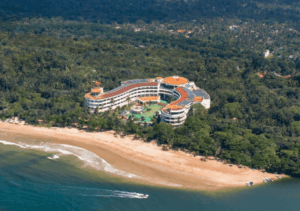
Explore the hotel’s accommodation and current offers, or contact The Eden Beruwala for help planning your stay. Few gardens reward a second, closer look quite like this one does.

